Friday, November 5, 2010

Societal Wars

So in shuffling through various blog posts, mainly in the hopes of finding a good quote (in all honesty) I came across an interesting response done by Constance on the subject of something called the"Beiber Wars". She comments on the lack of middle ground between "fans" and "haters"
"I find it extremely interesting that there is no middle ground, only the fans and the "haters". I think this says a lot about our society, actually"
-From Constance's Blog Post on the Beiber Wars
I find I agree with Constance on the irrationality of there being no apparent middle ground in these arguments, you are either classified as a hater or fan. I find that this is the case in many arguments, for example, you are either pro-gay or anti-gay, you are either pro or anti- abortion, you are either pro or anti-Obama, and these are just a couple examples of popular either-or debates that come up in everyday life. But I must ask, can you honestly say that Beiber is worth arguing over? I myself, like Constance, don’t like or dislike his music, I’ve never really listened to it. But as a person, having stumbled upon an interview on late-night tv a few times, I find him deplorable. That’s beside the point though. The main argument is over his music, no? One side argues that he sounds like “a girl” the other side claims that he is simply the best thing since sliced bread. It’s a never ending circle. Anyways, I ask you, the fighters of this war, if it is possible for you to come to an agreement over a middle ground, one that we viewers can tiptoe safely without being drawn into the never ending skirmish? And if you cannot allow a middle ground, might you, at the very least allow us to stay out of it.
eh, I’m not happy with this post....

Tuesday, November 2, 2010

Kites and Needles

In this first section of the book (pg. 1-124) we are introduced to the main characters, Amir and Hassan. Amir is a troubled young boy, struggling to find his place in a man’s world, one which his father has pushed him into against his will. Amir’s father, Baba, views his son as something of a challenge, something that needs to be molded, to fit his idea of a man, perhaps because of some atrocity that appeared in his own childhood, one he is trying to save his son from. And lucky young Master Amir’s best friend, Hassan, is spared from a similar fate. Hassan is a Hazara, a race viewed simply as unclean, inferior, compared to the Afghani. So, while Amir suffers from a oppressing culture, Hassan is in some ways freer than his friend. Though he does not attend school, he has a quick mind, and is indeed capable of many things the rest of their world say are impossible for a Hazara. So here, pretty basically, are your main characters for the time being.
Delving into the underlying meanings in the language, or put simply, reading between the lines, you see a more complex weave of connections, more ways in which you might finally understand a character’s mind. You start to notice the subtleties in mannerisms each character uses towards other characters. And if this makes no sense, try placing yourself in the book, a silent,invisible, witness to every scene described, and watch. Simple watch the small changes in grammar, the way they move their hands, everything. And eventually you’ll see a pattern in the chaos, a pattern, that when interpreted correctly can tell you a characters exact feelings towards another character, and hints towards what they may be hiding. The language in this book is fascinating, in some areas, foreign words are explained, and in others, they leave you to use context and wits to figure it out for yourselves. It’s somewhat like a foreign friend saying an unfamiliar phrase, and rather forgetting to explain what it means. The incorrect grammar is also interesting, when used in dialogue indicates translation to English from another language, as if someone were remembering the tale and retelling it in another tongue.

Friday, October 29, 2010

Looking Back for the Last Time, I Hope

How has blogging affected my writing, and were do I get my inspiration? These are the questions I ask myself often, and overall, I’ve actually found them fairly hard to answer, but after a few tries I came up with a few surprisingly simple answers. Over the past quarter, I’ve seen my voice come out more in my writing, some small frustrations with a lack of improvement, and that my inspiration comes from my everyday life.
Since I’ve found working backwards helps me write sometimes, I’ll start from the end. My inspiration for so many writings has come from many unexpected places. When I first started writing these blog posts, I would struggle, reaching for the nearest subject I thought might work. But as I relaxed more and got used to the blog system, I began to pull topics more easily from my everyday life. I pulled things from class discussions, like my post on evolution. I also commented on upcoming holidays, seen in my halloween/bioshock post. I even wrote about recent discoveries like the mass grave found by a railroad. I am amazed at the variety of topics I’ve managed to come up with and honestly, can’t help but wonder how. But I won’t argue with my brain when it actually works right. So if the meaning of all that isn’t clear I’ll restate it: my inspiration is life itself. See here, a quote from a post about my uncles new book:

“Hey guys, remember a while back when I mentioned my Uncle Alan's first book was         hitting the shelves? Well, last night, the cover for book two,  A Cure For Chaos  was unveiled at a book signing in Billings, Montana. I am very proud to claim the artist who did the cover as my father”
I took one look at this in the context of trying to find my inspiration, and said “woah. this makes sense, life is my inspiration” Because really truly I seem to find the best topics in everyday life. But let me ask you a question, what is there really to talk about other than yourself? You found that article and wrote about it. You commented on the biology discussion. You speak of your experiences, your conversations, etc. It’s an interesting theory, because no matter how hard you try to not talk about yourself, you always must.
Well of course, everyone hopes to see an improvement in their writing, and looking back upon my past blog posts, I can’t help but hope with all my heart and soul that I’ve gotten better at writing. Because every time I look back I want to delete everything up there and replace it with something better. And, as you probably guessed, this is a vicious cycle. If I were to delete it all and write new stuff, end of next quarter I’ll want to do it all over again. I call it the artist’s curse. Be it art, be it writing, or even speaking, you will always hate your work when you’re done with it. Now, most people are not blessed with this curse, for it really is a mixed blessing. It allows you to look at your work objectively, notice the flaws, notice what you did right (you will usually find more of the flaws) but it can easily head into the realm of the hypercritical. It also often leads people to dislike you, because rather than patting you on the head and saying “that’s nice dear” people with this curse will tell you the ugly truth, that you will always need improvement. To illustrate my point, I will throw you a bone and provide you with two quotes, one from a post that needs a lot of work, and the other from a post I actually find acceptable:
“Well, well, well... this is yet another piece of evidence that Q is overall unimpressed with         the world around him. He tells us that before the dinosaurs went extinct, he felt that they needed to be destroyed, not only needed to be destroyed, but they wanted to be destroyed.” (from my analysis of the Calvino Stories)

“This book is truly great, a twisting imaginative plot, great characters, and depth to the         settings. The book starts with an eighth grader named Jenni on the bus, on her way to a routine science class excursion” (from a Book Review on A Measure of Disorder)
With the first one, I see many flaws in only two sentences:
  • constant repetition of the word “destroyed”
  • poor sentence starter of “well, well, well”
  • poor grammar
  • to generalized explanation

With the second, I see fewer flaws, but would still probably edit the second sentence, as “on her way to a routine science class excursion” would make more sense said like this: “The book starts with an eighth grader named Jenni on the bus, out of school for the day for a scientific excursion”
So overall, I am unhappy with my apparent small amount of improvement and I feel that with all the practice I’ve been getting I should be better than I am.
    One thing I can definitely say I’m happy with though is my voice. I feel that over the past quarter my blog has allowed my inner voice to show, better reflecting my personality and who I am. With practice on the less structured writing styles, my formal writing has improved noticeably. But we aren’t talking about formal writing at them moment, we’re talking about my informal voice. My quote actually comes from a book review, believe it or not.
    “Everything is just dandy, until everyone falls asleep near the lake as a fog rolls in. They         wake up hours later, the fog gone, and aren’t on Earth anymore. They meet up with some interesting creature along the way, not all of them friendly, and everyone in the group changes into something from this new world, something more suited to their souls, their personalities. Everyone, except Jenni.”
Now, before you laugh, yes, I really do talk like this in person. I feel that this is a great example of how I really speak is shown better in my writing. Actually, this is one of the few things I like about my writing, how it sounds like me. It’s amazing, when I was in middle school, my teacher warned me that you should be more formal in all your writing, and be careful not to ask too many questions, or address your audience too directly. But I’ve found as I’ve gotten older that the reverse is true. People tend to love a bit more of a free style, they love challenging questions, and of course, they like to feel that they are the ones this is targeted at. So pretty much, voice is a good thing, and I’m proud that I’ve blended a bit more of mine into my writing.
    Now that I’m done looking back and shuddering at my own awful writing (I’m joking... I think). I’d love to look forward and think about what I can do to appease the almighty Artist’s Curse. I hope to branch off into even more subjects, hopefully ones that my audience will find a bit more interesting (do I actually even have an audience?) and ones that I myself find more interesting. I also want to better improve my vocabulary and find new words to use (redunant much?). Speaking of redundancy, I need to work on that as well, I seem to repeat myself and ramble quite a bit. Well there you go, my analysis into one small part of myself.

Tuesday, October 19, 2010

Society: Is it What it Seems?

The 1937 novella, Of Mice and Men, by John Steinbeck is about a pair of migrant workers, George Milton and Lennie Small. These two are seeking to make a stake and get themselves a small piece of land to call their own. In their world, it is rare to see two guys who are like brothers, who care what happens to the other one, so they are seen as something of an oddity. The main conflict in Of Mice and Men is character(s) vs. Society because George and Lennie are on the run from a community that rejects them because of a single mistake, because of a man named Curley, and ex-boxer turned farmhand who is bitter and ready to fly into action at any second, and because of Lennie’s disability.
So far, George and Lennie have escaped Weed and are in the clearing camping, when Lennie says something that set’s off George:
“You crazy son-of-a-bitch. You keep me in hot water all the time... Jus’ wanted to feel that girl’s dress - Well how the hell did she know you jus’ wanted to feel her dress? She jerks back and you hold on like it was a mouse. She yells and we got to hide in a irrigation ditch all day with guys lookin’ for us, and we got to sneak out in the dark and get outta the country... ” (p. 11)
Well, this shows that the main conflict in this book is character vs. society because it mentions how society has a block against trying to understand George and Lennie’s situation. Society believes that they are something of a danger, something that if messed with will (for lack of a better phrase) bite you in the ass. Society sees George and Lennie as a threat, because George is quick and smart, and Lennie, on the other hand, is large and fairly dumb. They believe that there is no way that their intentions are what they say they are. They’re seen as possible con men, judging by something the boss says later in the book. And this girl, this girl did not wait for an explanation, she just screamed and threw the boys into a pot of hot water from which they could have died trying to escape...
George and Lennie have just gotten their job and one of the stablehands’ dogs had puppies. Lennie has been given one, and stubbornly tries to have it sleep in his bed with him. After a sharp reprimand, Slim comments:
Slim had not moved. His calm eyes followed Lennie out the door. “Jesus,” he said “He’s jes’ like a kid, ain’t he.”
    “Sure he’s jes’ like a kid” (pg. 43)
This certainly shows society’s misunderstanding of Lennie’s disability. Earlier in the book, George actually has to tell a lie to get Lennie the job because society doesn’t like “Lennie’s type” He tells the boss that Lennie had been kicked in the head by a horse as a kid, and that his brain damage was not of natural causes. In some ways it makes you wonder why being kicked in the head is more acceptable than being born with a disability, and in other ways it shows people’s intolerance towards those different from them, especially those who “aren’t quite right in the head”
It’s been a while since they arrived at the farm, and Curley is lookin’ for his wife, whom he believes is sneaking around with Slim. He finds Slim, alone, applying tar to a hoof. Slim scares him for his mistake and everyone heads back to the bunk house. The guys are making fun of Curley while Lennie mulls over the prospect of their own plot:
... Lennie was still smiling with delight at the memory of the ranch.
    Curley stepped over to Lennie like a terrier. “What the hell you laughin’ at?” (p. 62)
Wow, not only does this show some underlying superiority problems in Curley, this and what happens next show how the ranch hands are unable or unwilling to mess with Curely too much for fear of losing their jobs. It goes to follow that Curley attacks Lennie, and when no one moves in to help, George orders Lennie to fight back in anyway he can. Lennie crushes Curley’s hand for his trouble. The hands have to scare Curley into not telling on Lennie and getting him fired, therefore showing that society, though not exactly against them, is unwilling to help them because Curley is the boss’s son and can destroy lives with a single word.
Overall this book truly shows society’s inhibitions toward a) Lennie’s disability and b) George and Lennie’s relationship. Curley is one such person in society, rejecting Lennie and George out of hand because they look different, the community in Weeds is another example, and lastly, Lennie’s disability is the cause of much strife withing society.

Sunday, October 10, 2010

Hey, Hey!

Hey guys, remember a while back when I mentioned my Uncle Alan's first book was hitting the shelves? Well, last night, the cover for book two,  A Cure For Chaos  was unveiled at a book signing in Billings, Montana. I am very proud to claim the artist who did the cover as my father ^_^

Cure For Chaos is due to -hopefully- be released in January of next year, and it's currently in the editing and revision process :)

Here's a link to the series site: http://www.mother-earthseries.com/
And a link to the cover for the second one: http://motherearthseries.wordpress.com/

Keep Readin'!

Saturday, October 9, 2010

Books, and more Books

Need a great book to read?
Try picking up a recently published book called A Measure of Disorder. It’s by an author named Alan Tucker, who owns a publishing business operated out of Billings, MT. This book is truly great, a twisting imaginative plot, great characters, and depth to the settings. The book starts with an eight grader named Jenni on the bus, on her way to a routine science call excursion. Everything is just dandy, until everyone falls asleep near the lake as a fog rolls in. They wake up hours later, the fog gone, and aren’t on Earth anymore. They meet up with some interesting creature along the way, not all of them friendly, and everyone in the group changes into something from this new world, something more suited to their souls, their personalities. Everyone, except Jenni. They go on to meet bad guys and resolve conflicts. I’d go into more detail, but you should really just read the book. What’s even better, is you don’t have very long to wait before the next one comes out. Book Two: A Cure For Chaos is due to come out in January of next year, while the cover art will be released this Sunday during Tucker’s book signing at a Borders in Montana. The cover is done by an artist in the area, and when Sunday rolls around, I’ll hopefully be able to post the cover art up here, and tell you who did it.
Unfortunately, due to the fact that MAD Design publishing is based in Montana, and is a fairly small company, the Mother-Earth series cannot be found in our local books store, but you can check out Amazon.com and www.mother-earthseries.com to find out more about purchasing your copy.
Here’s what some other people said about the book:

“... I was hooked! I could hardly put this book down... it is WELL written, well thought out, and the whole concept is completely insane. Which makes for one great Fantasy book”
-Austin, from readingteen.net

“A Measure of Disorder by Alan Tucker is a wonderful foray into fantasy and imagination”
-Tracy from Midwest Book Review

"... the plot really kept me hooked and I flew through the last hundred pages. I just had to know what was going to happen next."
- Aimee, From a Book Dork's Blog

"As I neared the end of the book, I found myself reading ravenously to find out what had happened. I'd love to give more details, but this is really a book that you just need to read to appreciate"
-Jessica, from a Fanatic's Book Blog

Friday, October 8, 2010

All Hallow's Eve

Anyone ever play Bioshock or Bioshock 2?
It is the perfect game for halloween.
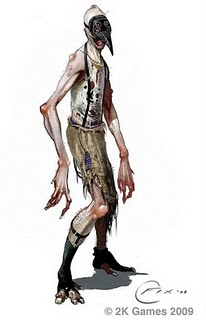
You start out at the entrance to an underwater city called Rapture. Built by a power hungry, insane man, this city was supposed to be an art deco paradise. Guns could be bought in vending machines, special tonics alowed you to splice your DNA and add abilities like telekenesis, and large.. things.. called Big Daddies prowl the streets keeping their charges safe, the Little Sisters. Everything was just dandy, until new years eve... the genetic splicing caught up with the residents of Rapture, turning them into splicers, that look like this:
Creepy, no?
And if that isn't enough, there are these guys:
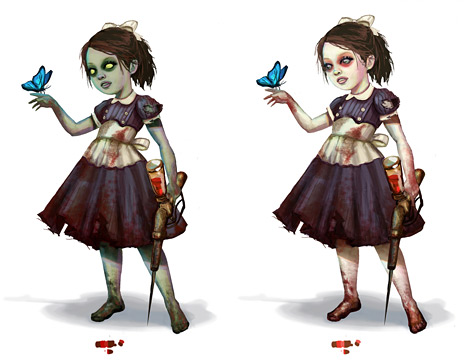
Little Sisters
These girls aren’t a cute or innocent as they look. In the game, they use you, Alpha, to help them hunt splicers to harvest a certain gene from them, called ADAM. They are controlled by a parasite living withing their neck. Once you help them acheive their goal, you can save them from the parasite, or kill them in cold blood.
Big Sisters
Heh, these girls can take care of themselves. Post-pubesent little sisters, they’ve grown up and gone back to their roots, except now they are the protectors of the little sisters. Armed with a paralyzing voice, various genetic splices, and a giant needle to stab you with. They aren’t something to be trifled with.
Now on to the best part:
Big Daddies
It isn’t easy being a Big Daddy. They start your training by literally ripping out your vocal cords, pumping you with genetic material called ADAM and EVE (Ironic, no? Considering the name of the city), dump a huge suit on you, and throw you out there, telling you to expect grave consequences if you make a mistake. You are then given your first Little Sister, who you treat like your own child. Even though she loves singing things like “the angels daddy”. She sees
the world as a perfect place, and loves stabbing the angels with her needles.
So I suppose this is a game review/info page... seriously, this is a great game to play this month. It so fits the whole Hallows Eve idea